Showing posts with label Palmer Station. Show all posts

Saturday, January 22, 2011

January 21: Good data and bad news

                                                  Crabeater Seals in front of Palmer Station
January 21, 2011

Today was almost identical to yesterday as the work day goes. We looked at penguin tracks and then figured out where we wanted to send the vehicle to investigate. We launched the vehicle and drove around for little bit making sure that everything was running smoothly.

After plugging in the second vehicle today we could tell it was not happy so we packed it up and are going to have to operate with only one vehicle from now on. 

We got some great data back from the REMUS that went out today and other than our setback from the leaky vehicle we had another great day. We spent a couple of hours on the water today tracking the vehicle, which was really nice to be out and about doing something other than sitting at our desk.   

We saw some crab eater seals hauled out on a piece of ice near the station, which is today's photo. We also saw the normal penguin groups going out to feed. Lots of boats from station have been seeing multiple whales in the area too, so it appears that they are arriving to feed in the local waters on their southern migration routes.  

Good night,  
Ian

Thursday, January 20, 2011

Jan. 19: Photo Ops


Jan. 14: Launching the REMUS units

January 19, 2011

Just a quick note to go along with two photos. Here's Mark (Moline) Jan. 14 - a monumental research day, as we set out to launch the two REMUS units.

The REMUS units are the black vehicles. The yellow vehicles seen in other photos on this blog are the gliders.

We're sending them out to gather data as part of a research project on the foraging environment of Adélie penguins on the Antarctic Peninsula. Our work is being paid for by a grant from the National Science Foundation secured by Mark (Professor Mark Moline).

You can read more about the grant paying for our work by clicking here to read the Cal Poly News Release about it.

In the photo below, you can see Mark testing the REMUS units on what passes for a balmy summer day in Antarctica.

You can find out more about the REMUS units on the Cal Poly Center for Coastal Marine Sciences by clicking on this text.


Testing the REMUS units

Jan. 19: Penguin Tracks, Launches and Frisbee Golf

January 19, 2011

Ian Robbins at Palmer Station in Antarctica
Today was clear and sunny with no wind again. I guess there is a small storm coming in a couple of days, so we decided to take advantage of the good weather and do an offshore mission to the canyon that we surveyed when the ship was close into the shore. 

Matt’s glider was in the area so we are going to match up data for the two vehicles and then look at penguin tracks also. 

We sent the vehicle out and it ran perfectly again. We knew where the iceberg was located so we planned ahead and it didn’t move today.  We went out after dinner and picked it up and then started to look at the data. 

I spent the rest of the day putting the other vehicle back together and making sure it was ready for action tomorrow.  We are not sure if everything is perfect, but it appears to be working???

Since it was so nice today, most of station was out playing after dinner. There was a game of Frisbee golf, hiking on the glacier and in the “backyard” and going boating. I’m getting excited because I heard a rumor that we might get to go climb in some ice crevices.  We will see how that goes with the weather. 

As you can see things are starting to settle into a rhythm here and we are getting used to our surroundings in this short-term home away from home.

Wednesday, January 19, 2011

Jan. 18: Beautiful, Beautiful, Beautiful Data

Jan. 18, 2011

I know I just listed off how many days we’ve been gone yesterday, but I was talking to the logistics person today and just figured out that we have to have everything packed up by the 3rd because the ship will be here on Feb. 4th.  That’s only two weeks away. 

Getting a glider relaunched

Mark, Matt and Kaycee went out to launch our good vehicle to cover the path that the other vehicle sprung a leak on yesterday. It has been operating flawlessly and has called in consistently to let us know it is okay. We love it when this happens. 

We were watching our local iceberg, which seemed drift right into the way of the return path of the vehicle so we headed out a little early and picked it up to bring it home. Beautiful, beautiful data!

While they were out I stayed back and tested the other vehicle and tried to get it back to working order, which means putting it back together and running some tests and then sending the data back to the manufacturer. Hopefully we will have some answers by later tonight.

Mark had another teleconference with school today with lots of excited questions from the students. We also returned to cooler temperatures and some wind today.  It made me realize how pleasant it has been the last couple of days.  

And that’s about it. I didn’t really spend much time outside today, so this entry will be pretty short unless anyone wants to hear about my Antarctic desk.


Jan. 17: Iceberg Trouble and a Little Luck

Jan. 17, 2011

A monumental day here in the South!  We sent out 2 REMUS’s today, which we have only done once before in a controlled environment. And down here, it is definitely not a controlled environment. 

We knew that some of the penguins had been feeding locally so we sent one vehicle to the south and one to north to cover a fairly significant chunk of the local waters. We dropped the first vehicle in the water, made sure it was okay and then went over to the other side of the island to drop off the second vehicle since there was an iceberg that was blocking our path. 

Otherwise we would have dropped them both in at the same spot and went back to lab.  When we arrived we found another iceberg sitting on the start location, so we had to do a little reprogramming of the mission to move the start point beyond the iceberg. 

After letting the vehicle go and keeping the other vehicle in the back of our mind we went over to look at an ice arch and some glaciers and then headed back to get some lunch. We had a sailboat visiting from Australia and the station invited them to eat lunch with us, which I’m sure was a treat for them after being on a sailboat for a while. 

I didn’t get to talk to them, but one of the scientists here went to explore the boat and found out it was built for an around the world sailboat race where it placed fourth.  It isn’t that big of a boat to be playing around on the big ocean.

I headed back to the lab to work on some of the data we had been collecting and some other work for projects back home. At the same time I was watching the computer and waiting for the vehicles to call in over the satellite phone. We got a couple of successful calls and were feeling good when one of the vehicles called in and said it had a leak. 

Of course it was at the farthest point from us in the mission. We got its location and took some notes on the other vehicle and then headed out to find it. During lunch we had noticed that one of the icebergs was heading directly into the path of the where the other REMUS was going to be coming home.  So now we had to worry about finding one vehicle and then racing back to make sure the other vehicle didn’t run into the iceberg. 

We made our way out to where the leaky vehicle was supposed to be and started looking for it with our towfish (same one we used to get the vehicle off of the bottom the other day). We were having trouble locating the vehicle because it was giving random distances and always seemed to be the same distance away no matter where we went. 

We went to a spot where we thought it was located based on our triangulation and we didn’t get a single ping. A little frustrated, we started to head inshore and Mark spotted it a hundred meters away, which the towfish should have seen without a problem. 

Confused and a little worried we picked up the vehicle and headed back to save the other vehicle. Another fortunate thing for us was the weather. There were no waves and no wind today so the ocean was like a lake. There would have been a good chance that we would not have found the vehicle if the ocean was rough.

We made it back to the iceberg, a little worried that the second vehicle had already arrived and maybe crashed into it, but found the iceberg had moved just far enough away from the path of the vehicle and that the vehicle had not gone by yet. 

Everything was going to be okay.  A couple more gray hairs I guess. 

We spent the rest of the night taking the leaking vehicle apart and looking at both missions to see what happened during their flight through the ocean. It doesn’t look like anything was damaged inside the vehicle, but we will have to wait and see how it flies tomorrow or the next day. 

Jan. 16: Penguin Fodder and Water Masses

January 16th, 2011

I realized today that we have already been gone for 21 days. I'm not really sure what I remember from the trip so far and I’m not sure if it feels like we have been here for a long time or a short time. This normally happens in field work, but it seems more evident right now.  I am really glad I am writing this so I can keep track of everything.

Today was the standard day off at the station, being a Sunday.  We slept in a little and worked on getting our vehicles in the test tank to run the batteries down so we know how they are going to react out in the water. We have been having some battery issues lately which affects how we program the vehicles and how far we can go on each mission. 

Everything looked pretty good, which gave us more confidence in being able to let the vehicles go. After bringing the vehicles in and getting them charged up for tomorrow, we went to an island called Amsler Island, which is where the original British research station. The American research station, Palmer Station, was created next.

The ground on Amber Island is mostly granite rock, mixed in with some fine sediment that is left from when the glaciers ground up the rocks as the passed over the area. There are still some glaciers covering part of the island, but mostly it is uncovered. There is also some moss and small plant life in areas. We saw a large Skua colony and a group of Elephant seals relaxing in a haul out area. 

Some of the Elephant seals were massive and we still haven’t seen one of the giant males or females. They have all either been adolescents or pre-adults. We made our way over the far side of the island (half a mile), which faces a massive glacier. We waited a while for some to fall off, but all we heard was some popping and moving. 

We ended the night planning the missions for tomorrow and then watching the Patriots/Jets football game. There was also a Gray whale that came into the harbor so a group went out to take pictures on the zodiacs. 


Penguin lunch: Antarctic Krill

On another note: Matt’s glider has also been flying really well after they put it back out, which is nice to hear. We haven’t got any good penguins tracks in the last day or so, so he has tasked it to station itself at a waypoint off of Palmer Canyon. 

This allows us to look at water exchange in the canyon and see if how and when different water masses pulse in and out, which will affect was grows in the water and therefore what the penguins will be eating.


The picture today is of Penguin stomach contents (i.e. penguin food/Krill).  The penguins pick these individually out of the water column.  This is also what we are going to be measuring with our vehicle using sound waves.

Jan. 15: Antarctic Saturday Hike

Jan. 15, 2011

Happy Saturday everyone!  Today was another beautiful day down here.  No wind, which is always a good day in my book.  It warmed up a little bit too, 41 degrees right now.  Almost feels like Hawaii here. 

Mark and I did a short mission today with the 2nd REMUS around the northern islands just to get some local data and make sure it was acting like it should.  Everything went great and we picked it up right before lunch.  Since everything went really well the last two days we are going to take tomorrow off and then start doing some longer missions offshore to investigate where the tagged penguins are foraging. 

Mark and I had clean-up duty after breakfast and lunch and then the whole station cleaned the station (House Mouse style).  We also had clean-up duty after dinner, which is quite extensive.  One benefit of being on the ship is you really don’t have to clean up after yourself at all, but I would not trade that for the food here. 

Mark Moline, Ian Robbins on a Saturday Hike
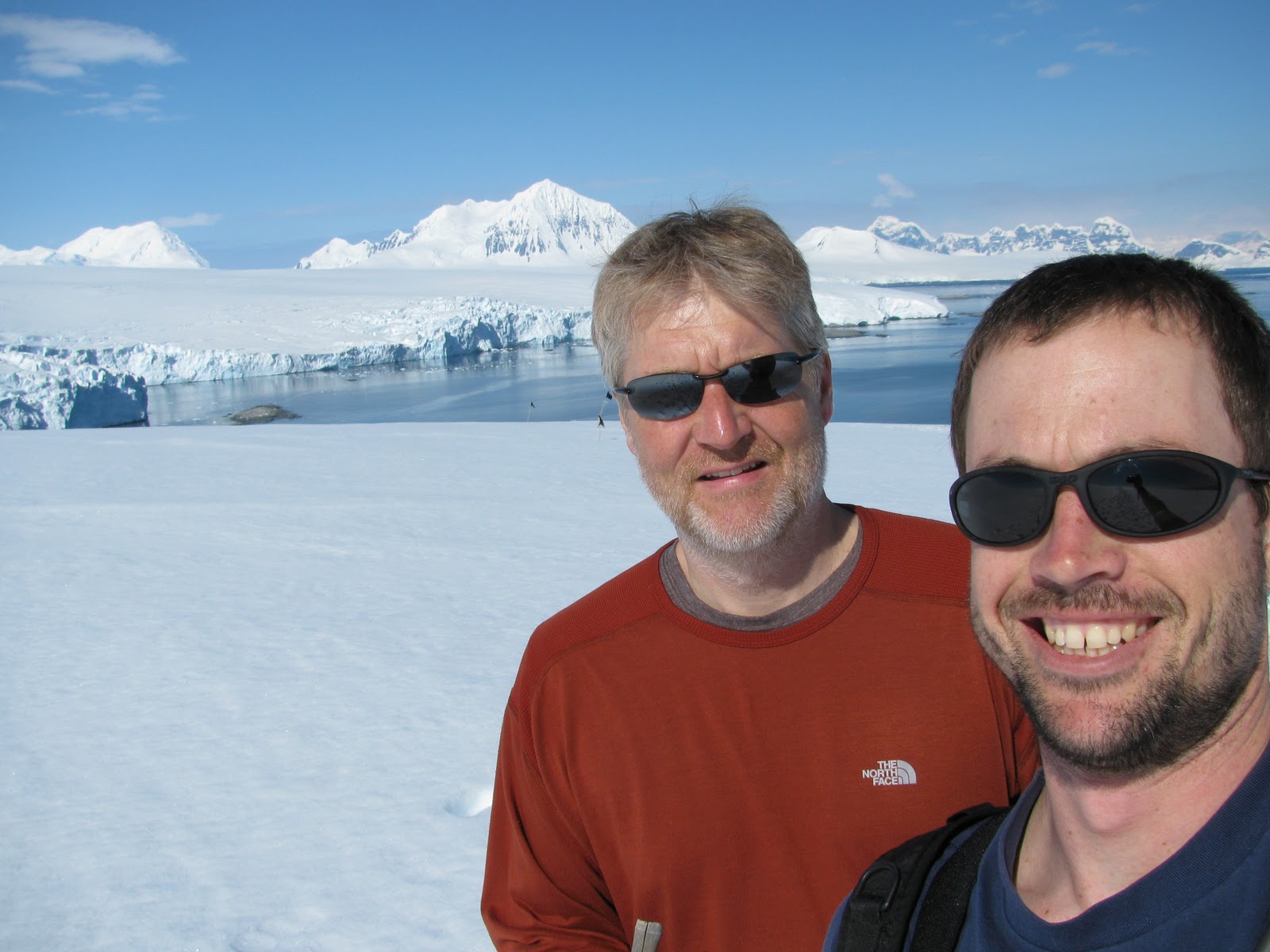
Almost forgot, Mark and I took two-hour hike up the glacier behind the station.  It is the same one we hiked when we first got here, but today we went all the way over to the other side to a little beach that had a backdrop of glaciers as far as we could see.  It is the same coastline we were boating along yesterday, but we were much closer now. 

It was a little bit scary because the ice can crack underneath and yet still be covered by snow, so we went slowly and took poking sticks to make sure we weren’t going to fall in.  It was beautiful being up that high and being able to see in all directions. 

Mark took bunch of photos in a circle that we are going to try to stitch together. Coming soon!

Jan. 13&14: Science Tour Guides and Remotes in Peril

Jan. 13 and 14, 2011

Today is a Friday 2 for 1 special for this journal about studying in Antarctica.  Time is flying by down here as Mark and I look at our clocks and realize it is getting late and we haven’t looked at the day’s data or replied to certain emails or taken care of other tasks.  This is normal for fieldwork, and is one of the many aspects of being in the field that we must manage and not drive ourselves crazy trying to do everything. 

Yesterday (13th) went well and as with every other day so far, brought some craziness.  Another cruise ship came into port today, named the Ushuala. A group of about 80 came in at different times, ferried back and forth from the ship by zodiacs. They roamed around the station and talked with the scientists and station members.  It has been a busy week for the ships, and I almost feel like this a tourist destination on some Mexico or Alaska cruise. 

In terms of an outreach program though, this is very important for people to see where their tax dollars are going and how the station facilitates the study of this area.  Everyone is very grateful and interested in the research that goes on here.

After sleeping in and catching up on lots of lost hours of sleep, we waited for the last zodiac of tourists to leave and loaded up our zodiac with the REMUS and anything else we needed.  We went around Bonaparte Point (right next to the station) and were about to drop off the REMUS when we noticed that our local iceberg had moved from where it had been the last couple of days. 

We went over and took a GPS position and it was sitting right in the middle of where the REMUS was supposed to run.  We changed the vehicles path and let it go. 

Being the first time going around the islands and having some other troubles flying in days past, we decided to follow it and make sure everything was okay. The mission was only supposed to last a couple of hours, so it would be nice to see some of the local islands. 

We got to see some more of the coastline and glaciers that pour off of the bigger islands and continent along with smaller local islands that are inhabited by penguins and seals.  At the end of the mission we noticed that the vehicle was not moving through the water anymore so we went over to inspect and found out from our towfish that it was stuck on the bottom in 25 meters of water. 

We got a little nervous, but at this point there is not much we could do other than react. Luckily the company has a command built into the towfish that allows us to end the mission, which stops the vehicle and spins the propeller in reverse. What this does is reverse it out of a hole or uncoil seaweed that has gotten stuck in the propeller. 

Fortunately this worked and the vehicle floated to the surface (Its does not always work).  Lucky again! 

We picked it up and returned to the station to figure out how we could change the flight of the vehicle to make sure that this doesn’t happen again.  We spent the rest of the night looking at data, and downloading pictures and video of the day.     

Today (14th), we went out to launch the vehicle that had problems calling in.  We got a software fix from the manufacturer so we needed to test it out in and see if it had worked.  Yessss!  The vehicle called in over the satellite phone so we can set it free in the next couple of days to swim around and we don’t need to worry about it or follow it. 

While this vehicle was under the water we went over to look at the iceberg, which had made a friend during the night. Another iceberg was parked right next to it.  When I say iceberg, I mean a chunk of ice the size of a football field and we could only see 1/10 of it (the amount that floats above water).  We would have to change the path of the next mission again so we would stay away from them if they moved. 

After lunch we dropped off the second vehicle and went back to the station.  We will now be monitoring the vehicles from the station as they call in and then go out if they have any problems. This allows us to work on other things instead of sitting in a zodiac and having to look at each for a couple of hours.  

Everything went great and we went out to pick it up after dinner.  Hopefully the data is great.  The glider group also went out to pick up a glider that was getting pushed around by currents and the birders and bug group went out and had an eventful day. Almost forgot, we had a couple of visits from a leopard seal close to the dock today. Scary creatures!

We finished up the day by going over to Torgersen Island and walked around to look at the penguin chicks (and adults).  Very interesting to see the groups of penguins nurturing their chicks and then to see the Skua flying inches over head looking to pick them off.  Nature at its best. 

Well, I’m off to look at data and get ready for tomorrow.

Jan. 12: Rescuing a REMUS

January 12th, 2011


Great Success!  We just returned from retrieving the REMUS after it flew 10 miles offshore.  We were not anticipating being ready to do this quite yet, but the LMG (ship we came down on) will be sampling right on the edge of Palmer Canyon and we wanted the vehicle to be there when the ship was, just like with the gliders yesterday. 


Cal Poly Professor Mark Moline (l) and Cal Poly Researcher Ian Robbins (r)
Rescue a remote research sub (REMUS) from an iceberg.

We went out to look for it a little early because the REMUS had not called us over the satellite phone to let us know it was okay.  It was fairly calm when we went out, but quickly got windy and cold along with blowing snow.  Of course when the wind blows on the ocean, waves are created so we had a bumpy hour and a half not hearing from the vehicle.

We were getting nervous when we started getting some hits from the vehicle on our acoustic tow fish, which is how we communicate with the REMUS units underwater. This device uses an electric current to expand a material that makes a sound wave that travels out to the REMUS. 

When the REMUS hears the “noise” it responds with the same “noise.” The tow fish calculates how long it took to get the return signal and figures out the distance knowing the speed of sound underwater. The vehicle can also use a series of noises to tell us where it is and what the battery, depth sensor, and speed are doing. 

Once it came up to surface we spotted it and picked it up, which is never easy in bouncing waves and wind with snow blowing in your face. We took it home and downloaded all the data to look at tomorrow.  I also sent all of the data from the run yesterday to the REMUS manufacturer to figure out why it was not calling home. 

While the REMUS was out, Matt and Mark were working with the ship to make sure everything was sampling in the same area.  In a scary moment the ship went right over the glider. We don’t know what depth it was at, but it was deep enough to escape the propellers. The ship took some net tows to look at what was swimming around in the water and they also filtered a bunch of water. 

So what was a mass of chaos in the early hours turned out to be okay with everything ending up in the same area at the right time, which got everyone very excited.  Afterward the ship picked up the glider that was launched a couple of days ago in 40 knot winds (crazy). 

On a sad note, the glider that we launched last night has not called in for over 12 hours so we are not optimistic at this point. This glider was going to look at the food sources in the water, very similarly to the REMUS but for a longer time period.  We will keep our fingers crossed that it pops up tomorrow.

The sky’s turned back to gray today as the weather reports predicted storms and high winds in the next couple of days so we will see what tomorrow brings and figure out what to do next.  We saw a couple of whales today along with lots of penguins swimming around us. 

We have seen Adelie, Gentoo, and Chinstrap penguins. At this point there have only been Humpback whales so far, but there are also Blue whales, Minke whales and Orcas swimming around.  I am also amazed at the ice and how it moves around after it fall off of the glaciers. 

We almost couldn’t get out of the harbor this morning to go release the REMUS.  The food and people also continue to amaze me down here.

Jan. 11: Icebergs and Technical Difficulties

Jan. 11, 2011

Today has been a long and crazy, but good day.  We woke up to a huge layer of ice from the glacier covering the whole bay this morning.  The skies were blue and the sun stayed out all day today.  We can see everywhere.  The mountains behind us and the mountain range to south are spectacular. 

I had a couple of last tests to run on the REMUS and then we went out and to launch one of Rutgers gliders (another collaborator on this project).  Since the whole bay was covered with ice, it took a long time to weave our way through the ice, pushing big and little chunks out of the way so we could get out to open water. 

Once we were on sight we were amazed at the views, but realized we had to get back to work.  We dropped the vehicle off and came back to station. Usually the glider calls back in every 3 hours, but this one did not so everyone was getting a little worried.  This happens from time to time and things do get lost, but it is still stressful.  We were going to have to wait and see if anything happened. 

In the mean time, Mark and I took the first REMUS out to do a short run and calibrate its compass, which would take about an hour and a half.  We put the REMUS in the water, started it and watched it take off with the beautiful landscape in the background.  Ten minutes into the run we heard Matt call over the radio that he was going out to the station where the glider was last seen. 

Apparently, the piston on the front jammed in the down position and sent the glider to the bottom of the ocean, which luckily was only 90 meters. The gliders are only rated to 100 meters. Once it didn’t come up it dropped a little lead weight and floated to the surface. 

Mark and I sat out and waited for the REMUS to finish up and watched penguins go swimming by, along with a couple of whales. We picked up the REMUS and brought it back to the station to download the data and make sure it was flying okay and get ready to do the second one tomorrow.  After dinner we went and launched a second glider that will be flying offshore to study another penguin foraging site. 

The ship that we were on came in close to the coast line today and was taking water samples and running a lot tests.  They will pick up the glider that we launched a couple of days ago and take it with them to another study site.  I just find out that they launched a glider before we got down here that is flying down to Rothera, a British research station. 

The station crew enjoyed the afternoon in the sun and the rest of the science crew continues to work on their projects, taking samples and spending time analyzing them in the lab. 

The glider crew has to work on the 2 gliders that are acting up and we will be preparing for tomorrow and looking at today’s data tonight.  Also, hoping for another beautiful sunset and nice day tomorrow.

Jan. 10: Rough Seas and Research

Jan. 10, 2011

Hi all.

It was another beautiful day today.  Actually, even better than yesterday since there was no wind.  It is amazing how I can feel warm and comfortable, then the wind picks up a little and everything feels like it is going to fall off.  Even in this warm weather (35 F) we have to wear full float suits and warm clothing underneath. 

We had another cruise ship arrive last night and come to visit the station today.  It is actually the ship that made the world news when it was crossing the Drake and got pretty beat up with busted windows and a bruised load of passengers.  I’m guessing everyone was happy to have good weather as well. 

We couldn’t really do much since they were bringing boats over with passengers to take tours of the station so I worked with the vehicles and got our new computer all hooked up with the vehicles and their software. 

 It is a fancy computer that allows us to work on the water and in cold environments when it raining and we are getting splashed with water, which is very important since the weather doesn’t really care if the vehicles or instruments are in the water.  Mark put together a poster to leave at the station that explains what we are doing for the tourists and station employees. 

He also had a class meeting set up with his sons class on Skype so that he could talk about everything and show them what we are doing down here. While he was doing this I went out with Matt and Kaycee (a student who has been working down here for Rutgers) and moved one of our transponders and deployed the second REMUS to work out any kinks.  Everything went very well and they got to see their first REMUS deployment.

It is always amazing to see these things get their propeller going and take off into the water and then come back in a couple of hours.  We watched penguins and tried to imitate their calls as they swam around us.  We were also keeping track of a couple icebergs that have been hanging out around the station since we don’t want to run into them with the REMUS’s. 

After we picked up the REMUS, we went back to station and got the other vehicle to deploy it again since we had some problems with the fluorometer and propeller calibration.  Mark switched places with Matt and Kaycee since they had to go work on another glider and get it working.  We sent out the other REMUS, waited for it to return and then grabbed some dinner. 

The glider crew had got the other glider working so we went out and deployed it so that it would be out sampling when the ship is on location so that we can take some net tows of what is in the water. This will allow us to count actual organisms and relate them to what the gliders and REMUS’s are measuring.  After watching the sun get low on the horizon we headed back to get some rest for tomorrow.

Jan. 10: Summertime in the Antarctic

Jan. 10, 2011

Well, I write from the tomorrow again (it’s after 12:00).  Today was one day off for the station folk so we had to fend for ourselves in the kitchen, which really meant digging through the massive stocks of food for breakfast and then eating the best leftovers I’ve ever had for lunch and dinner. 

Station folk spend their time relaxing, watching movies, playing music, hiking, camping and taking boats around to the islands that are open at this time of the year.  It was overcast again today and a little windy.  Remember, it is summer time down here and it hasn’t been above 35 degrees since I’ve been here. You definitely get used to it, though. I find myself getting lazy and not wanting to take the time to put extra layers on when I go outside, but then freezing when I get there. 

Just a heads up: Fen Montaigne, who wrote a book on Bill Fraser’s work on penguins around Palmer Station called "Fraser’s Penguins," will be on the Colbert Report tomorrow the 10th.  Please check it or the book out or look these items up on the Internet. 
(Find the Colbert-Montaigne Interview clip at:

They are quite interesting.  Bill Fraser is the person who Mark is collaborating with on the project to look at penguins and their food source, so this happens to have a direct link to all of us. 

We did not have the day off, but got to sleep in a little bit and move a little bit more slowly since we did not want to impact the station crew on their day off. 

We worked on the vehicles a little more and prepared the transponders (acoustic devices that the REMUS uses to help it navigate in the water) to be deployed in the water. We had to get weights to keep the transponders on the bottom and get line to hold the transponders to the weights and then buoys to make sure everything floats so that we can pick them up in a couple of weeks. 

The vehicle also uses GPS to navigate around, but it helps to have an accurate source close to home to help it return home.  We loaded everything into the boat and took off around the point to locate our first transponder site.  We normally have very accurate navigation charts in the United States, but similar information is very hard to come by down here. 

The ocean floor also changes rapidly so it took us a while to find our first site. But we finally got everything measured out, turned on and then set on the bottom.  We repeated this at our second site.  We returned after boating around some of the islands and a small glacier to make sure we know where everything is located. 

Some penguins kept coming by to check out what we were doing.  They are very curious animals and remind me of dolphins and sea lions who also want to know what we are doing in there ocean. 

After returning, we ate some dinner and then put the REMUS units and gliders into the tank in the lab to make sure they all float properly in the water so that they can fly more efficiently and more importantly come to the surface when they need to.  I set up a couple more instruments and played with the vehicle a little more and then it is off to bed. 

Mark just came down and pointed out one of the most beautiful sunsets I have ever seen.  It is really amazing, because it lasted so long and was an amazing pink. 

Jan. 8: Fish, Penguins and Bugs

January 8th, 2011

Today was a little more relaxed and comfortable as we settle into our new life here.  I started switching nose cones on the REMUS’s to get all the right instruments on the right vehicles.  We will have one vehicle that is measuring salinity, temperature, depth, water velocity/volume scattering, Colored Dissolved Organic Matter (CDOM), Chlorophyll a (plant matter), Turbidity (suspended particulate and biological matter), and upwelling/downwelling light at 7 different wavelengths in the visible light spectrum. 

The other vehicle will measure salinity, temperature, depth, water velocity/volume scattering, Chlorophyll a, and Turbidity. The two vehicle were not in these configurations when they arrived, which is why I have to switch them around. 

The station also had a visit from a small cruise vessel called “Big Fish”.  They got a tour of the station and Mark and Matt Oliver (who is running gliders and working with satellite data) gave a small presentation of the types of underwater vehicles that are here at Palmer Station and what their goals were. 

We have 4 gliders and 2 REMUS’s right now. This is unbelievable since there has only been 1 REMUS on station before and couple gliders, but none at the same time.  A glider uses a piston to change its volume or displacement of water, which allows it to sink or float in the water column. This allows it to use minimal battery power and stay out in the water for weeks at a time. It takes similar measurements to the ones I described above and moves at 0.5 knots.  The REMUS’s use a propeller and fins to move up and down in the water column and can move at speeds up to 5 knots.  Since they move faster, they use up power faster and need to be picked up after ~10 hours. 

After the tour we took a zodiac out and launched one of the gliders, which is out collecting data. You can find it here (http://marine.rutgers.edu/cool/auvs/index.php?did=195&view=imagery) if you want to check on it. 

Mark and Matt had a meeting with the penguin group to talk about plans for the next couple of weeks. The penguin group already have an established sampling routine so it is important work into their routine. The insect group went out collecting again as did the penguin group and other scientists continued to do their work. 

The station works a half day on Saturdays and then has House Mouse followed by a station meeting.  House Mouse involves pulling jobs out of a hat and then cleaning the whole station for the next hour. Mark and I worked with a group in the kitchen. 

The rest of the evening was spent putting the REMUS units together and then relaxing.  We watched Icebound, which is about a woman at the South Pole station who discovers she has breast cancer during the winter where there are no flights in or out for eight months.  It is fairly good depiction of what life can be like down here. 

Jan. 8: Antarctic Diving

Jan. 8, 2011

I’m going to work backwards on this one so bear with me.  I just jumped off of the pier into 34 degree water. I passed on this opportunity while in the Arctic this spring, but it was someone’s birthday and they had never jumped in, so a crew of 13 people took the plunge. 

Apparently, people do this all the time here.  It was definitely not as bad as I thought it was going to be, but it was definitely cold. The hardest part is breathing afterward.  Luckily there is a hot tub on station and we all rushed into it to warm up.  I forgot to mention that this was right after I finished working out at 22:00 and was going back to the lab to work, since we are still setting up our vehicles. So instead of working I find myself sitting in a hot tub and then the glacier across the bay starts calving (big chunks falling off). 

This is an amazing force of nature, which is even impressive from a half a mile away. The sound is similar to a huge explosion and then waves come racing across the bay and break on the rocks right at the station. 

Afterward I walked into the lab and was hit with a wall of smell from the table right next to ours, which was covered with bowls of zooplankton (small (pencil tip) shrimp like organsims) and krill (bigger shrimp like organisms) from the stomachs of the penguins on the surrounding islands. 

This is the food that we will be tracking with our REMUS’s (not in the stomachs of penguins). 

The rest of day involved boating class number 2.  Yesterday I had taken boating class number 1.  We started out by learning how to throw a safety rope, work a GPS, start a fire with a camping stove, and put up a tent. 

These are some of the skills that you may need (hopefully not) if you cannot make it back to the stations.  The station has placed stashes of equipment on different islands within a 3 mile radius of the station that are in barrels and contain anything you would need to survive until rescue team arrives or you can make it back to station. 

Just to make sure everyone understands what I just said, you make not be able to make it back to the station, which is only 3 miles away and usually less due to storms, ice, or some other unforeseen circumstance.  This rarely happens, but seriously?  It is funny thinking about this because I am looking outside and a snow storm just blew by and the whole bay is now covered with ice chunks from the glacier calving.  Things can change pretty quick around here. 

After lunch we got in the zodiacs and drove around the 3 mile boating area to get familiar with all the islands and stash locations.  We learned how to land a boat on the rocks to get on shore, call back to the station on the radios, and rescue a person that has fallen overboard.  We got to go ashore on the island where the original Palmer Station was located for a couple of minutes.

I was taking pictures and out of the corner of my eye I see a Skua coming right at me. Just to paint a picture this is a bird slightly smaller than an eagle and apparently is very territorial.  Now by coming right at me I mean flying head high and not going to alter its flight path until it hits my head.  I left the area!  We saw penguin colonies and southern elephant seals on most of the islands.  Once again, pretty amazing to be in the presence of these animals and this place.

During the man/woman overboard drill we had the option of putting on an immersion suit, which keeps you dry and warm if you fall overboard.  We put on the suits and one person at a time fell of the boat and were then picked up to practice dragging someone out of the water. Really fun, but I termed this drill the Leopard Seal lottery.  

Thank you everyone for passing this around and I hope everyone is enjoying the daily journal.

Jan. 6: Palmer Station

January 6th, 2011

I'm actually writing this entry before midnight.  Yayyyy!  Well ladies and gentlemen we are officially Palmer Station residents. It has been a crazy day here, both on the station and on the ship, as everybody makes their final preparations for the ships departure and as we get settled in.  We had kitchen/food orientation at 08:30 this morning so we had to wake up early and clean out our steel container house and pack our luggage up to our new rooms.  We turned in all of our linens and ate our final meal on the ship (really!). 

After double checking that everything was off of the ship we went and met one of our chefs, whose name is Beaver. Don’t know the story yet. We found out how to do our own dishes, where food scraps go, where food is located, where to sign up for cleaning duty. 
After processing all this I feel like we are living in a commune a little bit. In a great way though.  Everyone is part of the machine and everyone takes care of each other and chips in. It is an amazing feeling because everyone that works here has made the choice to be here and accepts the need for all of this. Maybe it is also because of our reality show complex these days that I almost feel like we are part of a show in a way. 

After kitchen orientation, we moved on to waste orientation and then on to lab orientation, where we learn what goes where, how to get anything we need, and the general operation of the laboratory environment. There are groups already on site and a couple of groups that are moving over from the ship that are from universities all over the U.S. 

The science groups are studying everything from viruses to bacteria, to insects to penguins, phytoplankton and zooplankton and general oceanography. Most are ongoing studies based out of the station. The neat thing is they are all located in the same room, within walking distance so everyone kind of peeks over each other shoulders and are always asking questions. 

After orientations on orientations about orientations we had a little break and then time for lunch. All I can say is that I might not come back just because the food is so good here.  Artisan café mixed with 5 star restaurants.  Can’t say much more other than take a picture of the lineup for every meal.  After lunch we took a boating class to get cleared to ride in the boats. 

Then we had the rest of the day off to work and get set up in our lab. I installed our satellite phone for the REMUS units (remote Environmental Measuring Units) to call back into.  For those of you who haven’t heard of the REMUS’s, these are the underwater robots that we use to map, sample, and study the ocean. We also got our computers checked out to make sure they were clean and secure for the station. 

We finished up the evening with a station/ship pizza and ice cream get together and then here I am writing about our day and getting ready to go to bed.  It has been snowing all day, with light fluffy snow, but none has stuck to the ground.  We had another seal hanging out for a little bit, but nothing else showed up to play today.

Jan. 5: Aloha from Antarctica

January 5th, 2011

Aloha from Antarctica,

I just noticed I got my dates wrong yesterday since I looked at my watch after midnight. So yes, today really is the 5th of January. A long four-day journey has finally come to a close after passing through the straits of Magellan and the Drake Passage. 

I awoke this morning after doing an XBT survey until 04:00 in the morning to see the beautiful mountains and glaciers that are Antarctica. Unfortunately, to my surprise we were still in the open ocean trying to save time and making a faster trip. 

I ate my breakfast/lunch and went up on deck and finally got a glimpse of the land through the fog and clouds.  We spotted some birds (sorry I do not know what they were) and three humpback whales spouting and diving, which is indicated by their flukes popping up in the air, along with a group of Adelei penguins swimming away from the ship.

One of the scientists had to deploy some equipment in the water so we slowed down and let her pump some water on board and make sure everything was operating correctly. We resumed our speed and prepared for our arrival approximately 30 minutes later.  I am not sure how to explain our arrival other than it being surreal. 

There was a low cloud layer that made everything grey, but there was still enough light to make the islands and mainland of Antarctica glow with a “godlike feel,” as one of the scientists put it.  We could see Palmer station set against a backdrop of glacier, granite rock and enclosed bay. 

Everyone, even people who had been down here before, were on deck or outside the bridge taking video and pictures of each other and their surroundings. As the captain backed the ship into the dock at Palmer Station, we could see a penguin community, a southern elephant seal community and an enormous glacier surrounding us. 

The small community of Palmer Station was out at the dock waiving and greeting us as the crew cast out our lines and pulled us in tight. Honestly, everyone felt like school children running around the playground.  I guess we really never do grow up.

The place where the ship docks, is a little fjord or valley that used to have a glacier extending down almost to the aft section of the boat.  There are 4 zodiacs (inflatable boats/rafts) in the water that can be taken out to do sampling or deploy instruments from, and a pier for the ship and other tourist vessels that pull up. 

There are 5 or 6 buildings where people live and work along with antennae for communication and storage tanks for fuel and water. Once we arrived we got a briefing on station rules and what the schedule was going to be for the next day. 

After taking a tour of the station and getting our Internet passwords and room assignments, we returned to the ship for dinner. Sadly, this will be our last meal on board.  We also made sure that our underwater vehicles were moved in the Palmer Station lab and plugged in. 

Then we got to go climb the glacier behind the station. To our left was a huge glacier that was cracking and rumbling and to our right was a view of the southern extent of the Antarctic Peninsula.  We took a lot of pictures and video and then returned to the station to hang out with the station crew and boat crew for a relaxing night together. 

Almost forgot: there was a leopard seal lounging on a small iceberg 100 meters off the shore and there were two Gentoo penguins hanging at the water line as we walked around the station. What a welcoming.  We did learn that we had to sleep on the boat tonight, so one more night of kinked necks and backs.